
CASE STUDY: A Global Institutional Asset Manager Moves from Salesforce to Dynamics 365 Sales
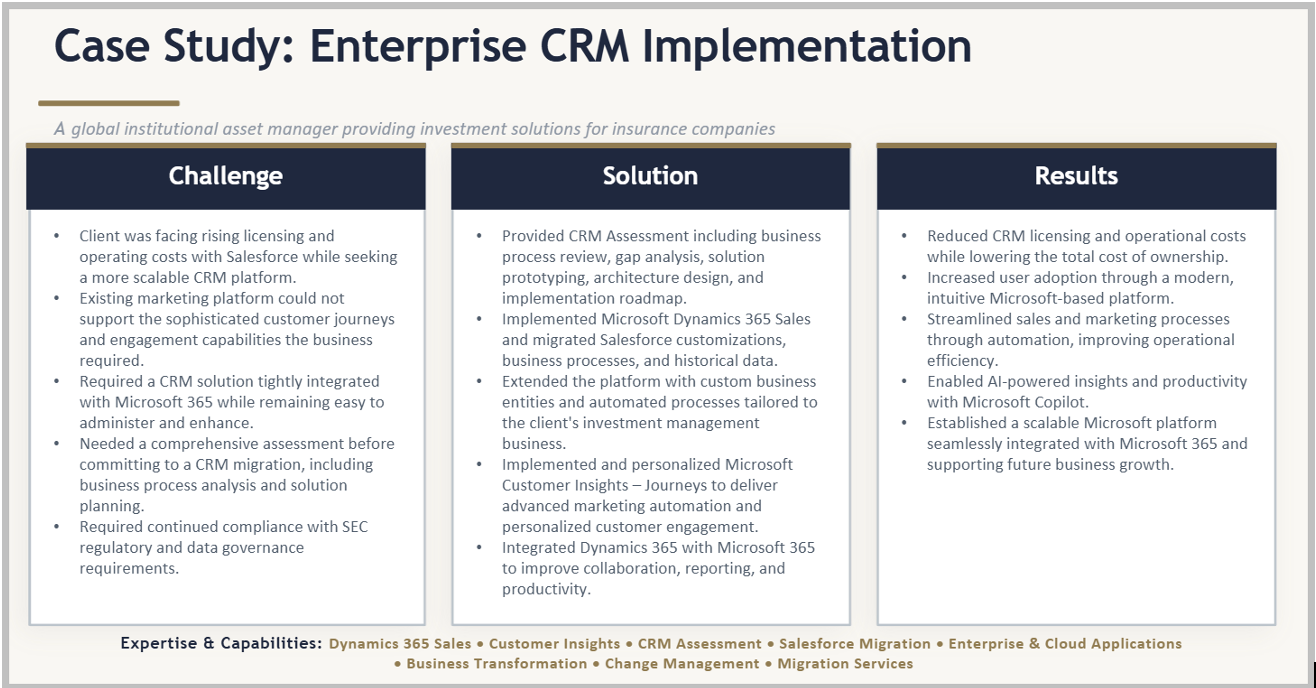
A global institutional asset manager serving insurance companies had reached a turning point with its existing CRM. Salesforce licensing and operating costs were climbing, and the platform wasn't scaling the way the business needed. On top of that, the marketing platform in place couldn't support the kind of sophisticated customer journeys and engagement the company's investment business required.
That's the situation this asset manager brought to Dexpro Dynamics.
The Challenge Before Dexpro
This wasn't a decision the company wanted to make quickly or lightly. Rising costs were one problem, but the bigger issue was fit. The business needed a CRM tightly integrated with Microsoft 365, one that would be easy to administer and enhance as the company grew, rather than another system that required constant workarounds.
Compliance added another layer of complexity. As a firm serving insurance companies, the business operates under SEC regulatory requirements and strict data governance standards, so any new platform had to meet that bar from day one.
Before committing to a move, the company wanted a real assessment rather than a leap of faith.
The Dynamics 365 Sales Solution
Our solution architects started with a comprehensive CRM assessment, not a sales pitch. That meant a full business process review, gap analysis, solution prototyping, and architecture design, all rolled into an implementation roadmap the company could evaluate before committing to anything.
From there, we implemented Microsoft Dynamics 365 Sales and moved over the company's Salesforce customizations, business processes, and historical data. We extended the platform with custom business entities and automated processes built specifically around their investment management business, rather than a generic template.
We also implemented and personalized Microsoft Customer Insights Journeys, giving the company's marketing team the advanced automation and personalized engagement capabilities their previous platform couldn't deliver. Finally, we integrated Dynamics 365 with Microsoft 365 to improve collaboration, reporting, and productivity across the organization.
The Results with Dynamics 365 Sales
The move paid off on multiple fronts. The company reduced CRM licensing and operational costs while lowering its total cost of ownership, and user adoption increased thanks to a modern, intuitive Microsoft-based platform that felt familiar to a team already working in Microsoft 365.
Sales and marketing processes are now streamlined through automation, improving operational efficiency across both teams. The platform also brings AI-powered insights and productivity through Microsoft Copilot, giving the company new tools for both selling and marketing.
Expanding Beyond Dynamics 365 Sales
With Dynamics 365 and Microsoft 365 now working together, the company has a scalable Microsoft platform in place, one built to support future growth rather than require another overhaul down the line.
If your organization is weighing the cost and limitations of your current SalesForce CRM system, let’s start the conversation and help you compare Microsoft Dynamics 365 Sales.